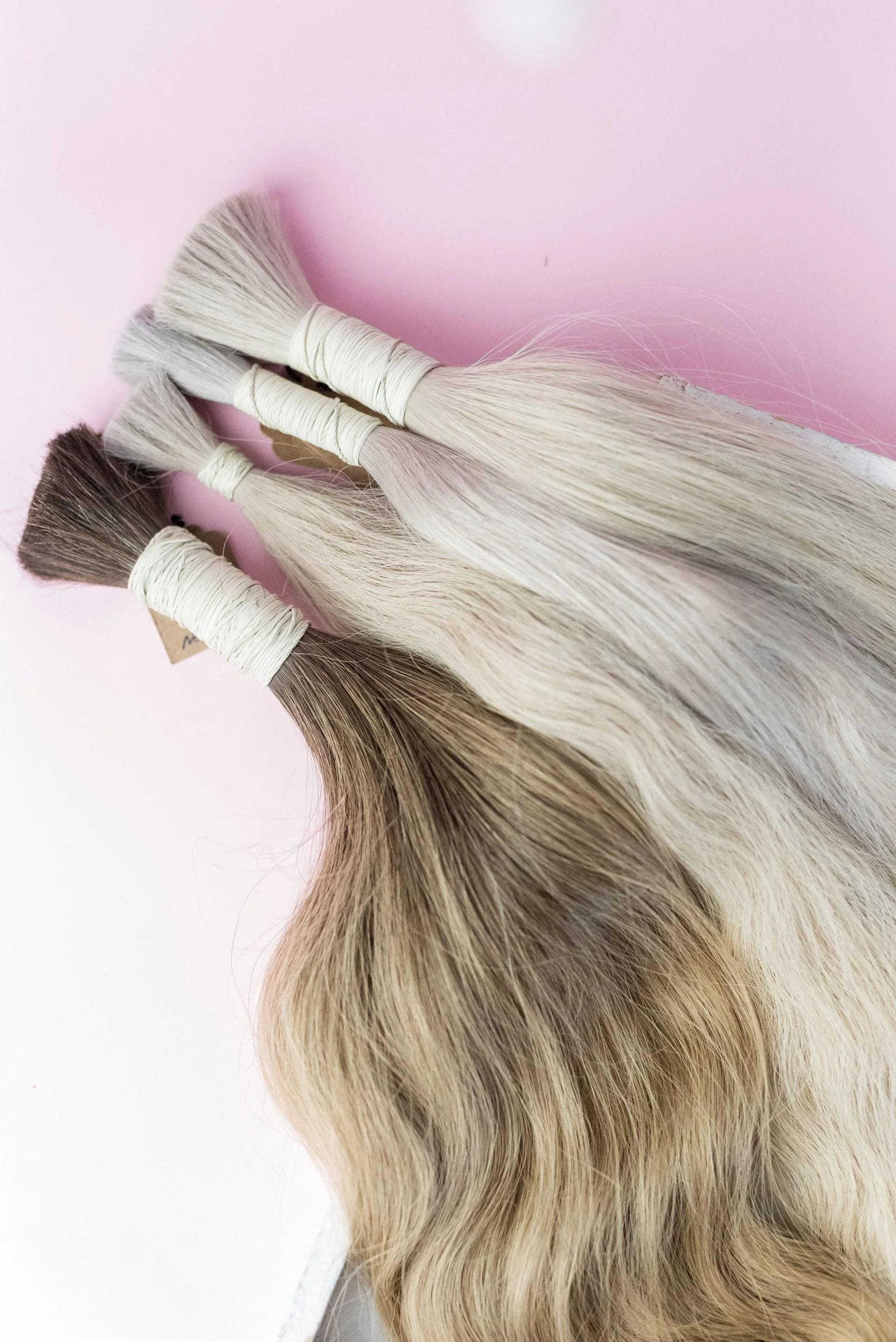
Almost every extension listing says human hair, and almost none explain what grade. That gap is where people lose money, because two sets that look identical in a photograph behave differently by week six. Anyone comparing Remy hair extensions in Portland is really comparing how the hair was collected.
This is the technical bit made simple: what Remy means, why cuticle direction decides whether hair tangles, and how to test a set with your fingers first. If you are weighing cost against lifespan, the breakdown of care, cost and how long a set lasts pairs with this.
Quick Answers 1. What is Remy hair in one sentence? 2. Why does that matter? 3. Is it worth the extra cost? |
Why Cuticle Direction Decides Everything
One physical detail explains most of what people notice about extension hair, good and bad.
What is happening at the strand level?
- Each strand has an outer cuticle that overlaps in one direction, like roof tiles
- Remy collection keeps every strand root end down, so the layers stay parallel
- Parallel cuticles let strands slide, which is what smooth hair actually is
- Reversed strands catch on their neighbors and lock, which is matting
- Cheap hair is often stripped of cuticle and silicone coated to fake the feel
- The coating washes off, which is why a bad set turns after weeks, not days
That last point is why so many people conclude extensions do not work for them. The set was fine on day one, so the grade never gets blamed. Portland clients who have had one bad experience are surprised by how differently good hair behaves, which the before and after work shows more usefully than any description.
Remy Compared With the Alternatives
What are you actually choosing between?
| Hair Type | How It Behaves | Honest Assessment |
|---|---|---|
| Remy human hair | Cuticles aligned, slides rather than catches | The standard worth paying for |
| Single donor Remy | Aligned and consistent in texture | Best match for one head of hair |
| Non Remy human hair | Directions mixed, tangles as coating wears | Cheap now, replaced sooner |
| Stripped and coated hair | Smooth in the packet, rough after washes | The most common disappointment |
| Synthetic fiber | Cannot be heat styled or colored | Costume use, not daily wear |
| Blended human and synthetic | Unpredictable under heat | Hard to recommend for a fitted set |
Rows three and four are what most bargain sets really are, and neither is dishonest if the label says so. The problem is that both get sold as human hair, which is technically true and practically useless in Portland or anywhere else. Anyone searching hair extensions near me needs one filter: ask where the hair came from.
Making Good Hair Last
Buying well is half of it. The other half is handling, and this guidance comes from dermatologists, not a brand.
What protects hair you have paid for?
The American Academy of Dermatology recommends letting hair partly air dry before styling, using a flat iron only on dry hair at a low or medium setting no more often than every other day, and leaving a curling iron in place for a second or two. It also advises keeping brushing to a minimum, noting that 100 strokes a day can cause split ends, and handling wet hair as little as possible because it breaks more easily. All of that applies to extension hair, with one difference: it has no root feeding it, so nothing you damage recovers. Portland weather does not change any of it.
- Let hair partly air dry before styling or combing
- Flat iron on dry hair only, low or medium, no more than every other day
- Leave a curling iron in place for a second or two, not longer
- Keep brushing to a minimum and be gentle at the attachment
- Handle wet hair as little as you can, since it breaks easily
- Go easy on long lasting hold products, which roughen combing
The American Academy of Dermatology guidance on styling without damage has the full list. Follow it and a good Remy set stays usable long enough to be refitted more than once, which is where the value appears. The aftercare routine for a fitted set covers the washing side in more detail.
What Penelope Fits in Portland
The studio fits 100 percent real human hair in a range of colors and textures, and works with Great Lengths and Bellami hair. Penelope orders and matches it herself rather than fitting whatever a client arrives with unseen.
How is the hair chosen?
Color and texture are matched in person against your own mid lengths and ends, the step that decides whether a set disappears into your hair or sits on top of it. Remy hair sits alongside tape in, clip in, individual, fusion and keratin options, and appointments run Monday through Saturday, by appointment only at Westover Haus in northwest Portland.
- Free consultation before anything is ordered
- 100 percent real human hair in a range of colors and textures
- Great Lengths and Bellami hair used in the studio
- Color and texture matched in person, not from a photo
- Payment plans through Cherry, up to $10,000 with no hard credit check
- A 4.9 star rating across 58 Google reviews at the time of writing
If you have been quoted wildly different prices around Portland, hair grade is usually why, and it is fair to ask outright. Anyone typing hair extensions near me is comparing grades without knowing it. The payment plan options and how approval works mean quality need not be traded for affordability: Cherry runs a soft credit check, offers zero percent financing subject to approval, and quotes a regular rate of 9.99 percent to 35.99 percent with a down payment sometimes required.
Book a Free Consultation in Portland
Whether you keep a set or replace it is decided before anything is fitted. Get in touch to arrange a free consultation and you will get an in person color and texture match, a straight explanation of what hair is being ordered, and an honest answer on upkeep costs.
Portland Hair Extensions by Penelope | 2328 NW Westover Rd, Ste B, Portland, OR 97210 | (971) 400-8069 | directions and opening hours | recent work and client photographs
Call or text Penelope in Portland today to book your free consultation.
Quick Summary
Remy describes hair collected so that every strand stays pointing the same way, root end with root end and tip with tip, which keeps the cuticle layers on each strand parallel. Parallel cuticles let strands slide past each other, and that is what smooth hair physically is. When directions are mixed the cuticles catch and lock, which produces the matting that ruins a cheap set within weeks. All Remy hair is human hair, but a great deal of human hair is not Remy: it can be collected from mixed sources, stripped of cuticle and coated with silicone so it feels smooth in the packet, and it then turns once the coating washes away. That delay is why the hair grade rarely gets blamed. Single donor Remy is the most consistent option, while synthetic and blended fiber cannot be heat styled reliably. On care, the American Academy of Dermatology advises partly air drying before styling, using a flat iron on dry hair at a low or medium setting no more than every other day, leaving a curling iron in place for only a second or two, keeping brushing to a minimum, and handling wet hair as little as possible. Extension hair has no root feeding it, so nothing damaged recovers. Portland Hair Extensions by Penelope fits 100 percent real human hair, matches color and texture in person, and offers free consultations.
Key Takeaways
- Remy means every strand faces the same way, so the cuticles stay parallel
- Parallel cuticles slide, mixed ones catch, and catching is matting
- All Remy hair is human hair, but plenty of human hair is not Remy
- Stripped and silicone coated hair feels fine until the coating washes off
- Test a strand with your fingers: smooth down, slightly resistant up
- Extension hair has no root, so heat and brushing damage never recovers
- Ask where the hair came from and whether it is single donor, every time
Frequently Asked Questions
1. What does Remy hair actually mean?
Remy describes hair collected so that every strand stays pointing the same way, root end with root end and tip with tip. That alignment matters because the cuticle, the outer layer of each strand, lies in one direction like tiles on a roof. Keep the strands aligned and they slide past each other. Mix the directions and the cuticles catch, which is what produces the matting that ruins a cheap set within weeks.
2. Is Remy hair the same as human hair?
No, and this is where most confusion lives. All Remy hair is human hair, but plenty of human hair is not Remy. Hair sold simply as human can be collected from mixed sources with the directions jumbled, then stripped and coated to look smooth in the packet. It behaves well for a few washes and then does not.
3. How long does a Remy set last?
Handled well, considerably longer than processed hair, and that is the whole economic argument for it. Lifespan depends on how much heat you use, how you brush it and how often you wash. A set that survives a year of careful wear costs less per month than three cheap sets replaced in the same period.
4. Can I color Remy hair extensions?
Usually darker, rarely lighter, and never as a home experiment. Extension hair has no living root to recover, so lifting color out of it is far riskier than lifting your own. Ask before you buy if a shade change is likely, because it is easier to order the right tone than to correct the wrong one.
5. How do I tell good hair from bad in Portland?
Run your fingers down a strand in both directions. Aligned hair feels smooth downward and slightly resistant upward, which is the cuticle you can actually feel. Then ask the supplier or stylist where the hair came from and whether it is single donor. A vague answer is an answer.